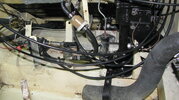
Dual Brake Master Cylinder

I dont know about others with fullsize spares, but i went to the used tire dealer and got the smallest tire that would fit on the spare rim- gives plenty of room!
 
I use a matching full size radial as a spare. Both work fine on my two cars, but since they are a different brand, one is a bit too thick for the hold down nut to grab the shaft. I made up a custom nut that reaches down a bit and that has worked fine for years.

John Friese
67 White
67 Red
 
Master cylinder is from 68-69 VW Bus with manual brakes - Available new from Bughaus for $140 or rebuilt A-1 Cardonne #11-1558 from local parts store for about $30. 7mm Brake hose, 10mm bleeder(to close off extra rear outlet) and nylon master cylinder connector pipes (small) all came from Bughaus. Lines from reservoirs to master cylinder formed from 40 inch pieces of 1/4" steel brake line. Plunger from brake pedal needs to be turned down slightly or master cylinder piston drilled out slightly for proper mating. Pretty simple and straight forward.
Ted


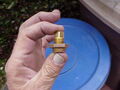
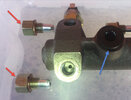
Thanks for this post. I want to do the conversion and building a shopping list but am not sure what "nylon master cylinder connector pipes" are? Are these what I am pointing two with red arrows or are you talking about the black cap. (Blue Arrow)? If so, is there a part number for these or a thread size to search and find? Can I assume from the other picture that you can get these in brass
 

Attachments

  • Brakes.jpg
    Brakes.jpg
    83.7 KB · Views: 20
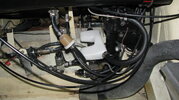
I have had my dual master cylinder in use for over a month now and its working perfectly and I have DOT 5 brake fluid! Maybe its me but the pedal seems more solid than the single circuit system and I seem to dry the brakes out quicker after being in the water! Its close to the spare but doesn't hit! On a side note, I just met a guy who flagged me down on my lake and he just bought an Amphicar! Its a complete car with not much rust at all but is needing restoration. He paid $4500. It was listed on craigslist in Western Mass. So they are still out there!!
 
Still no answer to my question, and hoping someone can add a little more clarity on what is needed for the non expert mechanic. Do the metal threaded connectors typically come with the masters cylinder? If they don't what are they called so that one can order them. Also what are the "nylon master cylinder connector pipes" that is described in Teds original post?
 
You'll need a dual master cylinder for a 68-69 bus: https://www.bughaus.com/master12.htm

Connecting pipes (elbows): https://www.bughaus.com/master_cylinder_connecting_pipe_-_113611153.htm

That fit into grommets: https://www.bughaus.com/brake19.htm

These are the parts I used in my dual master cylinder conversion.

You'll also need a dual reservoir (or another single). This is the one I used: https://www.bughaus.com/brake_fluid_reservoir_-_113611301L.htm

along with a custom bracket to mount it where the existing reservoir is located.
 
You'll need a dual master cylinder for a 68-69 bus: https://www.bughaus.com/master12.htm

Connecting pipes (elbows): https://www.bughaus.com/master_cylinder_connecting_pipe_-_113611153.htm

That fit into grommets: https://www.bughaus.com/brake19.htm

These are the parts I used in my dual master cylinder conversion.

You'll also need a dual reservoir (or another single). This is the one I used: https://www.bughaus.com/brake_fluid_reservoir_-_113611301L.htm

along with a custom bracket to mount it where the existing reservoir is located.

Thanks Ken for the detailed list!
 
The residual pressure valves on the 1969 Bus master cylinder were working a bit too well on our Amphicar; I was having problems with the brakes being locked up after sitting in the garage. I switched out the master cylinder at the start of this season with a 1967 dual circuit one that came without the residual pressure valves, and have had no problems since. I bought it nes, no core, from JC Whitney.
 
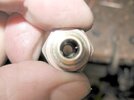
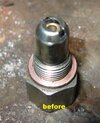
Aha! - found the answer! - They are "residual pressure valves": small check-valves, designed to keep a little bit of pressure in drum brake lines to reduce excell pedal "travel" or the need to "pump up" the brakes if they pull a but too far away after sitting. They were a feature on the 68/69 era VW master cylinders for VW's that had 4 wheel drum brakes. They eventually eliminated them, when brake servos became more popular. Amphicars are not too picky, and have effective brake-shoe adjustment cams to keep the shoes just barely away from the drum. The RPV's can be left as-is... but might make air-bleeding tougher, so here is a thread where they are gutted and used simply as pass-thru adapters (because that model 22mm dual master cyl is drilled for M12 to accept the valves...but Amphi brake line fittings are M10 - so you DO need the hex shaped metal nut to screw into!

see: https://www.thesamba.com/vw/forum/viewtopic.php?t=476304
Gut them and then they are just adapters
 

Attachments

  • open.jpg
    open.jpg
    45.4 KB · Views: 4
  • RPV1.jpg
    RPV1.jpg
    65.3 KB · Views: 4
Just did the conversion. I removed the residual pressure valves, they made it too difficult to bleed the brakes. I used a dual reservoir on the master cylinder and feed it from the one on the fender. The spare fits. A lot of brake pedal travel but there is still a lot left. My brake shoes are hardly worn so as they wear and fit better to the drums I should be able to adjust some of the play out. I ground the plunger that fits into the brake cylinder on a bench grinder so it fit nicely. I will post some pictures and a Bill of Materiels to make the process easier for anyone in the future. Stayed with DOT 4 and I use the Red Grease on the wheel cylinders to keep the water from seizing the pistons.
 
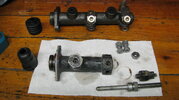
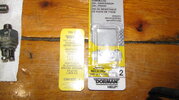
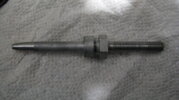
I have attached pictures and ordering information for all of the parts. I turned the outside of the Dorman adapter to 1/2" OD and drilled the other end so the fitting would thread into it. That connected the original reservoir (with a hose) to the new dual reservoir on the new master cylinder. I turned down the plunger so it would fit nicely into the new BMC. The brake lines have to be bent a little to fit without cutting. The residual pressure valves were removed to make bleeding easier. I suggest obtaining all of the parts before you do the conversion so you can get the car drivable quickly, the actual work doesn't take that long to do. Before doing anything you should make sure the brake system functions correctly, installing the dual BMC will not fix a non-fuctioning system. I stuck wheel cylinder piston will still be stuck, a broken or missing spring will still be missing or broken. Old, rotten brake hoses should also be replaced.
 

Attachments

  • Comparison.JPG
    Comparison.JPG
    1.1 MB · Views: 20
  • Doram Parts.JPG
    Doram Parts.JPG
    975.9 KB · Views: 22
  • Modified Plunger.JPG
    Modified Plunger.JPG
    640.1 KB · Views: 21
  • New BMC.JPG
    New BMC.JPG
    1 MB · Views: 22
  • Original BMC.JPG
    Original BMC.JPG
    1.1 MB · Views: 21
  • BoM.PDF
    BoM.PDF
    115 KB · Views: 20
I have attached pictures and ordering information for all of the parts. I turned the outside of the Dorman adapter to 1/2" OD and drilled the other end so the fitting would thread into it. That connected the original reservoir (with a hose) to the new dual reservoir on the new master cylinder. I turned down the plunger so it would fit nicely into the new BMC. The brake lines have to be bent a little to fit without cutting. The residual pressure valves were removed to make bleeding easier. I suggest obtaining all of the parts before you do the conversion so you can get the car drivable quickly, the actual work doesn't take that long to do. Before doing anything you should make sure the brake system functions correctly, installing the dual BMC will not fix a non-functioning system. I stuck wheel cylinder piston will still be stuck, a broken or missing spring will still be missing or broken. Old, rotten brake hoses should also be replaced.
@David T Glad it wasn't that hard. I purchased the master cylinder last month for future use and am going to swap it this winter. I can't locate most of the items on Bughaus (or bugstuffonline) using any of your BOM part numbers. They don't even show a reservoir that looks anything like yours that I can find. It looks like it must not have a cap and instead has an inlet hose that you feed off of the original reservoir. Is that correct? Does it have 2 fittings on the bottom that "plug in" to the top of the MC?

Would you mind going to the items and posting the actual link to each item?
 
Last edited:
The reservoir has 2 "nipples" that plug right into the rubber seals on the top of the master cylinder. It does NOT have a cap, it is filled by a remote reservoir. That one nipple/hose barb at the front gets connected to the reservoir on the fender. I reverse pressure bled the system to fill the reservoir on the BMC and then the one on the fender so the reservoir on the BMC would not be full of air. If you scroll down past the BoM you will see the actual orders from Bugstuffonline with their part numbers and the label from the box with the VW part #. Or you can just Google the VW part numbers and you will find the parts sold by other vendors. On the BoM the first # is a VW # and the second # is the Bugstuffonline #. The VW # for the BMC is supposed to be for the BMC without the residual pressure valves but it came with them anyway. In any case the valves can easily be removed.
David Teitelbaum
 
Top