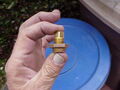
Since I was talking about the PCV system, it would have been appropriate for
John to also quote an earlier paragraph from the Wikipedia article that he
used for his authority:
The PCV system consists of the breather tube and the PCV valve. The breather
tube connects the crankcase to a clean source of fresh air, such as the air
cleaner body. Usually, clean air from the air cleaner flows in to this tube
and in to the engine after passing through a screen, baffle, or other simple
system to arrest a flame front, to prevent a potentially explosive
atmosphere within the engine crank case from being ignited from a back-fire
in to the intake manifold.
It would also have been ethical for John to cite the source of his quote;
you can read the full article on the PCV system at
http://en.wikipedia.org/wiki/PCV_valve .
Despite our desires to operate efficient and non-polluting vehicles, we
should also remember that an Amphi is a boat with an enclosed engine. As
such, safety is even more important than efficiency. Without a PCV system,
the 1147 cc engine exhausts an oily mist from the valve cover breather cap
and/or the engine crankcase breather pipe. Either way, the fumes go into our
bilge. At best, we get engine smells in the passenger compartment. At worst,
we get oil crud and fumes in the bilge, with increased fire / explosion
hazards.
Getting back to the original question of an oil puddle in the air cleaner,
there's no way that you should be seeing that with just a few hundred miles
on the engine. Since you just had it rebuilt, take the many suggestions that
have been brought up and discuss them with your engine rebuilder.
Ed Price
El Cajon, CA USA
WB6WSN
61 Rust Guppy
1987 MB 420SEL
_____
From: CapnJohn [mailto:]
Sent: Wednesday, June 03, 2009 8:53 AM
To: edprice@cox.net
Subject: RE: [General Amphicar Discussion-t-20445] Re: Oil in the air filter
housing
The PCV is there ONLY to control the crancase pressure. It is NOT an open or
closed valve. It does not prevent flames entering the crankcase nor is it
intended to. "The valve is simple, but actually performs a complicated
control function. An internal restrictor (generally a cone or ball) is held
in "normal" (engine off, zero vacuum) position with a light spring, exposing
the full size of the PCV opening to the intake manifold. With the engine
running, the tapered end of the cone is drawn towards the opening in the PCV
valve, restricting the opening proportionate to the level of engine vacuum
vs. spring tension. At idle, the intake manifold vacuum is near maximum. It
is at this time the least amount of blow by is actually occurring, so the
PCV valve provides the largest amount of (but not complete) restriction. As
engine load increases, vacuum on the valve decreases proportionally and blow
by increases proportionally. Sensing a lower level of vacuum, the spring
returns the cone to the "open" position to allow more air flow. At full
throttle, there is nearly zero vacuum. At this point the PCV valve is nearly
useless, and most combustion gases escape via the "breather tube" where they
are then drawn in to the engine's intake manifold anyway."